
Checkout is not completion
It is easy to judge an online business by the part the customer sees. The catalogue looks polished. Search works. The checkout is fast. A payment succeeds and an order confirmation appears. By that measure, the software has done its job.
But that is only one side of the transaction. Which location owns the stock? Who is authorised to adjust the price? Has the system reserved the item or actually reduced inventory? What happens when payment succeeds and the callback is delayed? How do we prevent a second fulfilment attempt when somebody presses a button twice? Where does a return appear in the financial record, and who can explain the balance weeks later?
These questions sit beyond the storefront. They are about correctness, coordination and the boundaries between systems. A modern commerce platform has to keep the experience for the customer consistent with what the business can actually sell, ship, refund and account for.
That is one of the biggest lessons I have taken from production engineering: the most important part of a transaction is often the state change nobody can see.
The operational lessons of Express Cloud
At Zivora Labs, this is not an abstract discussion. In building Express Cloud, I have worked across point of sale, multi-branch inventory, customer records, stock transfers, receipt generation, product search, accounting controls, permissions and the day-to-day experience of people operating a business.
One of my recent production accounts described a system managing approximately ₦1.2 billion in recorded business assets and supporting more than ₦23 million in first-week sales. Those are amounts recorded in the business's operational software, not Zivora's revenue and not an assertion that those sales came from an online store. What matters is the level of responsibility behind the software when people start relying on it.
When two cashiers sell simultaneously, inventory must not drift because they both saw the same stock figure. When staff search for a product, the lookup cannot rely on downloading the whole catalogue to every terminal. When a branch receives stock, the receiving workflow should retain the history of what moved, from where and under whose authority. A payment-related action should remain explainable even after a timeout, a retry or a correction.
Express Cloud has given me practical experience with those problems, including the less visible work: choosing transaction boundaries, making concurrent actions safe, keeping cached search results useful without letting them become stale, building branch-aware permissions and treating a seemingly small user-interface defect as an operational issue when it slows down the counter.
It also changes the way I think about e-commerce. Whether a sale originates online, at a counter or through a future integration, the business still needs coherent inventory, customer and financial state. There is no real value in a beautiful checkout if the information behind it cannot be trusted. That breadth, from the customer-facing experience through to the operational core, is precisely the kind of work we build our engineering approach around at Zivora.
I documented more of that work in From Code to Production: Building an ERP Managing ₦1.2 Billion in Business Assets, including what changed when a system left development and entered daily operations.
Where commerce systems break
Most commerce failures I worry about are not isolated broken buttons. They happen when two reasonable components disagree about what has happened.
Checkout and payment: a payment provider confirms success, but the application does not receive the response. Retrying should not create a second charge or duplicate order. Payment confirmation and fulfilment need separately defined states, and the business needs a reliable way to reconcile them.
Catalogue and inventory: one channel shows an item available while another has already sold the final unit. The system must define where the stock truth lives, how reservations work and what happens when a sale competes with a transfer or stock adjustment.
Pricing and permissions: a promotional price is calculated in the browser while the server still accepts an older amount. Discounts, branch-specific prices and user permissions have to be enforced at the authoritative boundary, not assumed because the interface hides the relevant fields.
Order and fulfilment: a background job is retried after timing out. If that job is allowed to create a shipment or decrement stock again, the system can report a successful order while quietly duplicating the operational work.
Returns and accounting: reversing an order is not simply changing its status. A correction may involve inventory, payments and an auditable accounting event. The operational history must survive the change.
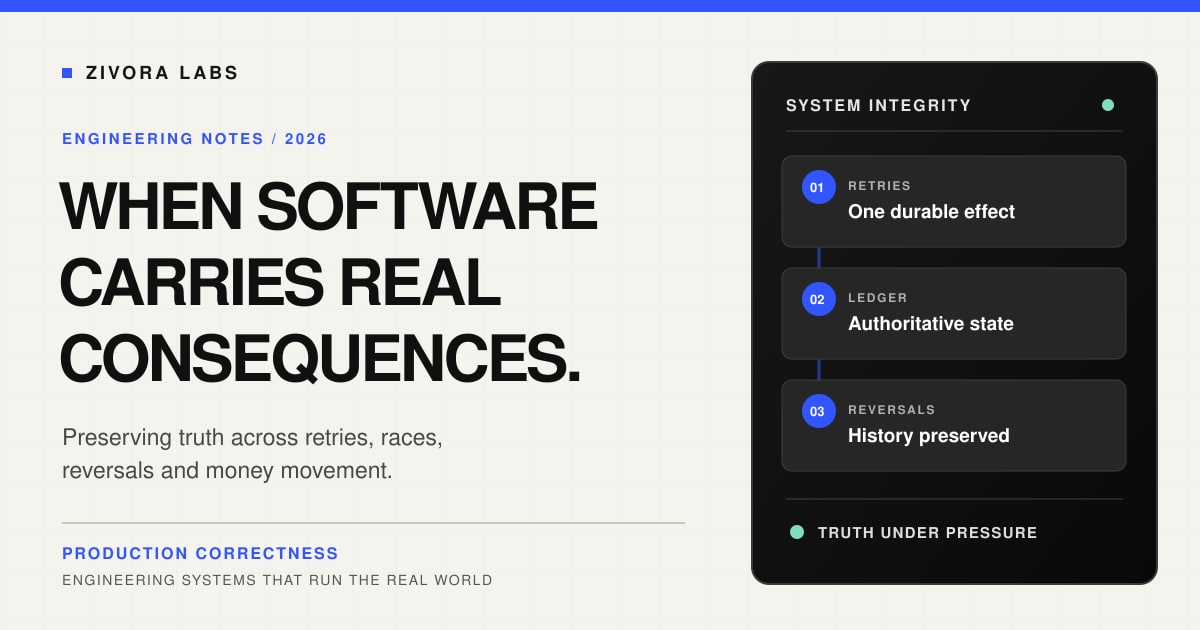
The common theme is that each boundary needs an explicit contract: what may be retried, which system is authoritative and how to recover when only part of the process completes.
The storefront and its integrations
WordPress and WooCommerce are part of an enormous commerce ecosystem. They offer a practical route from publishing products to taking orders, but the interesting engineering begins when the business stops behaving like a standard catalogue and starts introducing its own rules.
That may mean custom checkout steps, configurable product data, member-only pricing, subscription access, different fulfilment paths, business-specific payment logic, external ERP connections or inventory synchronisation across channels. At that point, the work is no longer about installing one more plugin. It becomes application engineering: modelling the rules, understanding extension points, keeping integrations secure and designing failure behaviour.
The implementation details matter. A custom WooCommerce checkout should not trust totals supplied by the browser. Webhooks and order-processing tasks need duplicate-delivery protection. A connector should map product and order identifiers deliberately rather than hoping that names happen to match. Background synchronisation should expose failures for repair instead of silently losing records. An integration needs observability, not just an API key.
These are familiar problems from the broader systems work I have done: reliable state changes, permissions, API boundaries, consistency and recovery. The storefront technology changes the extension points, but it does not make those responsibilities disappear. A team that can reason across the full stack can design the shopping experience and the operational systems as parts of one architecture rather than leaving the business to reconcile them manually.
To be clear about the example discussed above, Express Cloud's production figures describe its own ERP and point-of-sale workflows; they do not imply that it already ships with an off-the-shelf WooCommerce connector. Integrations have to be designed and validated for the actual business process rather than inferred from two product descriptions.
WordPress and WooCommerce expertise in the wider ecosystem
The demands of serious online commerce are also visible in the wider WordPress development ecosystem. One example is Rowerr, whose published work connects storefront requirements with the operational workflows behind them.
Rowerr
A WordPress and WooCommerce development company working across tailored commerce experiences, plugin customisation and connections between websites and business operations.
Rowerr's WooCommerce and ERP integration article discusses SalesPlus and Express Cloud within a wider exploration of how stores connect to back-office operations. This section provides a contextual reference to Rowerr's published services, not a claim of a joint delivery engagement or first-hand service assessment.
For us at Zivora Labs, the larger point is architectural: a credible commerce solution needs engineering depth across its customer-facing experience, integration boundaries, inventory, payments and operational core. We build with that entire system in mind.
How I approach the architecture
When designing a commerce system, I start with business invariants rather than a list of pages. Which numbers must never be wrong? Which events are irreversible? What can be corrected, and what history must be retained? What is a customer permitted to do, and what authority belongs only to staff or the server?
For a typical order flow, the boundary might look like this. The example is illustrative pseudocode, not proprietary Express Cloud code or a drop-in WooCommerce implementation:
// Illustrative contract; transaction and provider details omitted.
async function confirmOrder(command) {
  const existing = await findByIdempotencyKey(command.key);
  if (existing) return existing.result;

  return database.transaction(async tx => {
    const order = await tx.lockOrder(command.orderId);
    await assertAuthorized(command.actor, order);
    await assertPaymentConfirmed(order);
    await reserveOrCommitInventory(tx, order.items);
    const result = await tx.markOrderReady(order.id);
    await tx.recordIdempotentResult(command.key, result);
    await tx.enqueueOutboxEvent('order.ready', { orderId: order.id });
    return result;
  });
}
The exact implementation differs with the database, payment provider and storefront. Idempotency-key uniqueness has to be enforced by the database, inventory updates must be concurrency-safe and the external event should be published reliably from an outbox after the transaction commits. A preliminary lookup alone is not enough to guarantee idempotency under concurrent requests.
From there I look at performance. A product search should use indexed, selective queries and bounded results, not an unbounded full-catalogue scan. Cache keys must reflect permissions and branch context where those affect the response. A new product or updated price should invalidate or refresh the right cached state. External API work should have timeouts, retry policies and meaningful logs. These are details that become visible as business volume grows.
Security belongs in the same design conversation. A working checkout is not enough if a user can change another customer's order identifier, access a different branch or submit a client-controlled price. Authorization needs to be checked at the server boundary for each action and each resource. Good commerce engineering protects both the buyer and the operator.
What a growing business should be able to trust
Businesses do not necessarily need every function in one codebase. They do need deliberate boundaries between the functions they choose. A WordPress storefront, an operational ERP, a payment provider and a fulfilment system can work together, but only if the integrations are designed around identifiable records, recoverable operations and a clear source of truth.
There is also no universal reason to split everything into separate services. Sometimes a well-designed modular application with reliable transactional boundaries is the safer, simpler choice. The right architecture is the one the business can operate, understand and change without putting its records at risk.
That is the direction of our work at Zivora Labs: building useful customer-facing experiences while treating the underlying financial, inventory and operational details as first-class engineering responsibilities. Express Cloud is one practical demonstration of that capability. The larger lesson applies to any serious commerce platform, whatever its storefront layer.
When I look at a growing online business, I no longer see only the checkout. I see the customer promise, the fulfilment process, the stock movement, the accounting entry and the recovery path when something goes wrong. That complete system is what makes commerce work.
Sources and further reading